Error: Contact form not found.
Canada’s refugee system has always carried two responsibilities at the same time.
The first responsibility is humanitarian: Canada must protect people who genuinely fear persecution, torture, risk to life, or cruel and unusual treatment in their home country.
The second responsibility is public: Canada must maintain a refugee system that is fair, credible, timely, and trusted by Canadians.
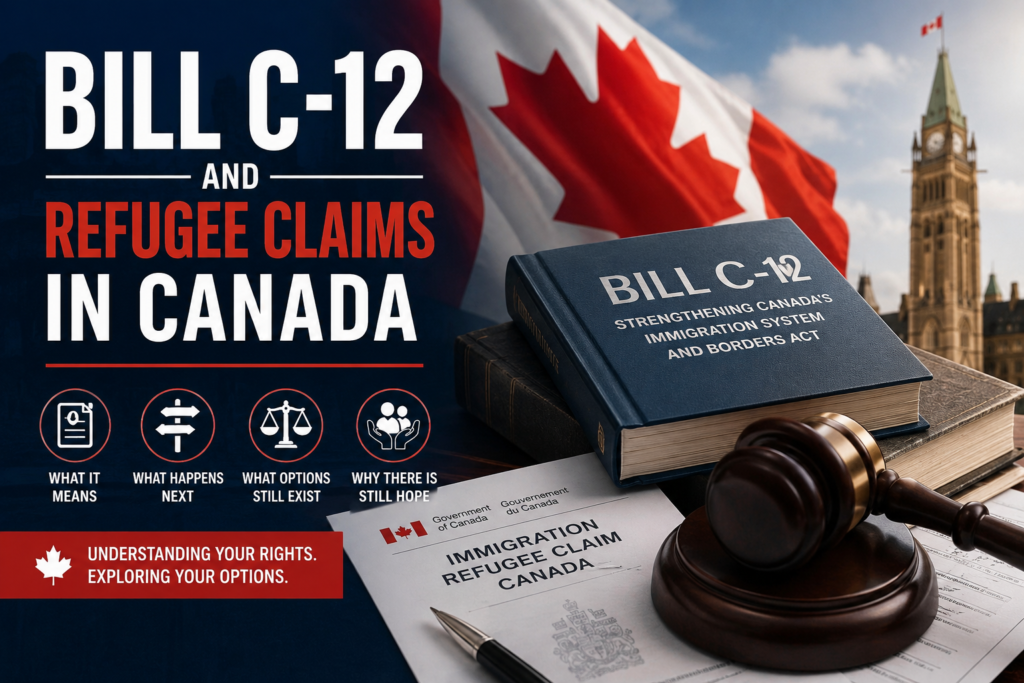
Bill C-12, formally known as the Strengthening Canada’s Immigration System and Borders Act, is now part of Canadian law. The Government of Canada has stated that Bill C-12 strengthens the immigration and asylum system in four main areas: new asylum eligibility requirements, a modernized asylum process, domestic information sharing, and new authorities relating to immigration documents and applications. Bill C-12 received Royal Assent on March 26, 2026.
For many refugee claimants, however, the most serious part of Bill C-12 is this: some claims may no longer be referred to the Immigration and Refugee Board of Canada (IRB) for a regular refugee hearing.
This has caused understandable fear and confusion. Many people came to Canada believing that they would eventually explain their fear before the Refugee Protection Division. Now, some are receiving letters from IRCC saying their claim may be ineligible under the new law.
The purpose of this article is to explain what Bill C-12 means, why the government says it was introduced, what may happen after a Procedural Fairness Letter, and what legal options may still remain.
Most importantly, affected people should understand one thing clearly: Bill C-12 may change the legal route, but it does not mean that every door is closed. There may still be legal remedies, protection options, and humanitarian applications available.
Under Bill C-12, new eligibility rules apply to certain asylum claims. The government has stated that these rules apply to claims made on or after June 3, 2025.
One major rule affects people who make an asylum claim more than one year after their first entry into Canada after June 24, 2020.
Another rule affects some people who entered Canada from the United States between official ports of entry and made a claim after 14 days.
In these situations, the claim may not be referred to the IRB for the regular refugee process.
In simple words, this means that a person may still say they fear return to their country, but their case may not proceed through the normal IRB refugee hearing process.
Instead, if they are found ineligible, the matter may move toward CBSA removal processing and, in many cases, the person may later be considered for a Pre-Removal Risk Assessment (PRRA).
This distinction is very important. An IRB refugee hearing and a PRRA are not the same.
The IRB is an independent tribunal. A PRRA is generally assessed by an IRCC officer, although in some cases a hearing may be scheduled.
PRRA is designed to assess whether the person would face persecution, torture, risk to life, or cruel and unusual treatment or punishment if removed from Canada.
From the government’s point of view, Bill C-12 is meant to protect the integrity of Canada’s asylum system.
Canada has experienced significant pressure on the refugee system in recent years. A system under pressure can create long delays, large backlogs, inconsistent public confidence, and difficulty focusing resources on the most urgent cases.
The government has presented Bill C-12 as a way to improve asylum claim processing, introduce new ineligibility rules, and protect the system against sudden increases in claims.
It has also linked the law to broader border-security and immigration-integrity goals.
There is a public interest in having a refugee system that works. Genuine refugees should not have to wait for years because the system is overwhelmed.
Canadians also need confidence that the refugee system is being used for protection, not as a substitute for regular immigration pathways.
If public confidence is lost, support for refugee protection itself can weaken.
At the same time, fairness cannot be measured only by speed.
Some people delay making a refugee claim because of trauma, language barriers, lack of proper legal advice, fear of authorities, misinformation, mental health issues, family pressure, manipulation by unauthorized agents, or misunderstanding of the Canadian legal system.
Some people may have very real fear even if their claim was not made quickly.
This is why the response to IRCC, the PRRA process, H&C options, and Federal Court remedies remain so important.
A strong system must be both firm and fair. Bill C-12 may be intended to control misuse and manage pressure, but affected individuals must still be given a meaningful opportunity to explain their circumstances and use the remedies that Canadian law continues to provide.
If IRCC sends a Procedural Fairness Letter (PFL), it should not be ignored.
A PFL is not always the final refusal. It is usually an opportunity to respond before IRCC makes a final eligibility decision.
This response should be treated seriously.
It should not be a short emotional letter saying only, “I am afraid to go back.”
A proper response should explain:
Where possible, the PFL response should include supporting documents.
Even if IRCC later makes a negative decision, the PFL response is still important.
It can become part of the record for future legal steps, including judicial review, PRRA submissions, an H&C application, a deferral request, or an urgent stay motion before the Federal Court.
If IRCC decides that the refugee claim is ineligible and will not be referred to the IRB, the person may become subject to removal procedures.
In many cases, the file may move toward CBSA.
CBSA may schedule an interview or appointment.
A person should not ignore CBSA communication.
Missing appointments, hiding, or failing to cooperate can create serious legal problems.
At the same time, the person should understand that removal processing does not always mean there are no remedies left.
A Pre-Removal Risk Assessment (PRRA) is one of the most important legal options for many people affected by Bill C-12.
PRRA allows the person to explain why they should not be removed from Canada because they would face danger in their country of return.
A person generally cannot simply start a PRRA whenever they want.
IRCC states that a person can apply for PRRA only if a CBSA officer tells them they are eligible.
In some PRRA cases, the decision may be made in writing. In other cases, IRCC may schedule a PRRA hearing.
If the PRRA is successful, the person may receive protection from removal.
In some cases, yes.
A person whose refugee claim is found ineligible under Bill C-12 may also consider an application for permanent residence on humanitarian and compassionate grounds (H&C).
An H&C application is different from a refugee claim and different from a PRRA.
It focuses on whether, because of the person’s overall circumstances, it would be unfair, harsh, or disproportionate to require them to leave Canada.
There is also an important warning: filing an H&C application does not automatically stop removal.
H&C should be treated as part of a broader legal strategy.
If IRCC makes a negative eligibility decision, refuses a PRRA, or makes another legally reviewable decision, the person may have the option of applying to the Federal Court of Canada for judicial review.
Federal Court is not a full new hearing where the judge hears the entire story again.
The Court usually reviews whether the decision was lawful, reasonable, and procedurally fair.
If the Court grants relief, the matter is usually sent back for redetermination by a different officer or decision-maker.
If removal becomes imminent, another possible remedy may be a formal request to CBSA for deferral of removal.
A deferral request is different from PRRA and H&C.
It is usually focused on whether removal should be temporarily delayed because of urgent circumstances.
If CBSA refuses to defer removal, a person may seek a stay of removal from the Federal Court.
Bill C-12 has changed the legal landscape for many refugee claimants in Canada.
Some people who expected a full IRB refugee hearing may now face an ineligibility decision.
That is a serious development.
But affected people should also not lose hope.
Bill C-12 does not mean Canada can simply ignore risk.
It does not mean that PRRA disappears.
It does not mean that H&C is never possible.
It does not mean that Federal Court remedies are unavailable.
It means the legal strategy must be adjusted quickly and carefully.
The first step is to respond properly to the PFL.
The next steps may include:
Every case is different.
The message for affected individuals and families is simple:
Do not panic, but do not delay.
Do not ignore letters from IRCC or CBSA.
Do not assume your case is finished.
Get proper legal advice, gather your documents, respond on time, and protect your legal record from the beginning.
Bill C-12 may have changed the route, but for many people, there may still be a road forward.
Bill C-12 is legislation that introduced changes to Canada’s immigration and refugee system, including new asylum eligibility rules.
Yes. Some claims may no longer be referred to the IRB depending on timelines and entry circumstances.
A Procedural Fairness Letter is an opportunity for a claimant to respond before IRCC makes a final decision.
In many situations, yes. PRRA may remain available if a person becomes eligible through CBSA removal processing.
No. Filing an H&C application does not automatically stop removal from Canada.
In urgent situations, the Federal Court may grant a stay of removal if legal requirements are met.
This article is for general information only and should not be taken as legal advice for any specific case. Every immigration matter depends on its own facts, documents, timing, immigration history, and applicable law.
Rattan Immigration is operated by Abhishek Rattan, RCIC-IRB, a licensed Canadian immigration consultant authorized to represent clients in immigration and refugee matters.
You can verify the status of licensed immigration consultants through the College of Immigration and Citizenship Consultants public register:
https://college-ic.ca/protecting-the-public/find-an-immigration-consultant
Error: Contact form not found.